- Democracy Bulletin
- Posts
- Democracy Bulletin, May 2026
Democracy Bulletin, May 2026
News from the CEU Democracy Institute
DEMOCRACY BULLETIN
News from the CEU Democracy Institute
This 20th edition of the Democracy Bulletin, the quarterly newsletter of the CEU Democracy Institute (DI), spotlights our accomplishments and publications from the past months, including unprecedented media attention, the new call of our Leadership Academy, and updates from our research groups.
If you don’t want to miss any of our news items, events, publications, podcasts or videos, then please follow us on Facebook, Twitter, BlueSky, and LinkedIn.
HIGHLIGHTS
Call for Applications: CEU Democracy Institute Leadership Academy 2026
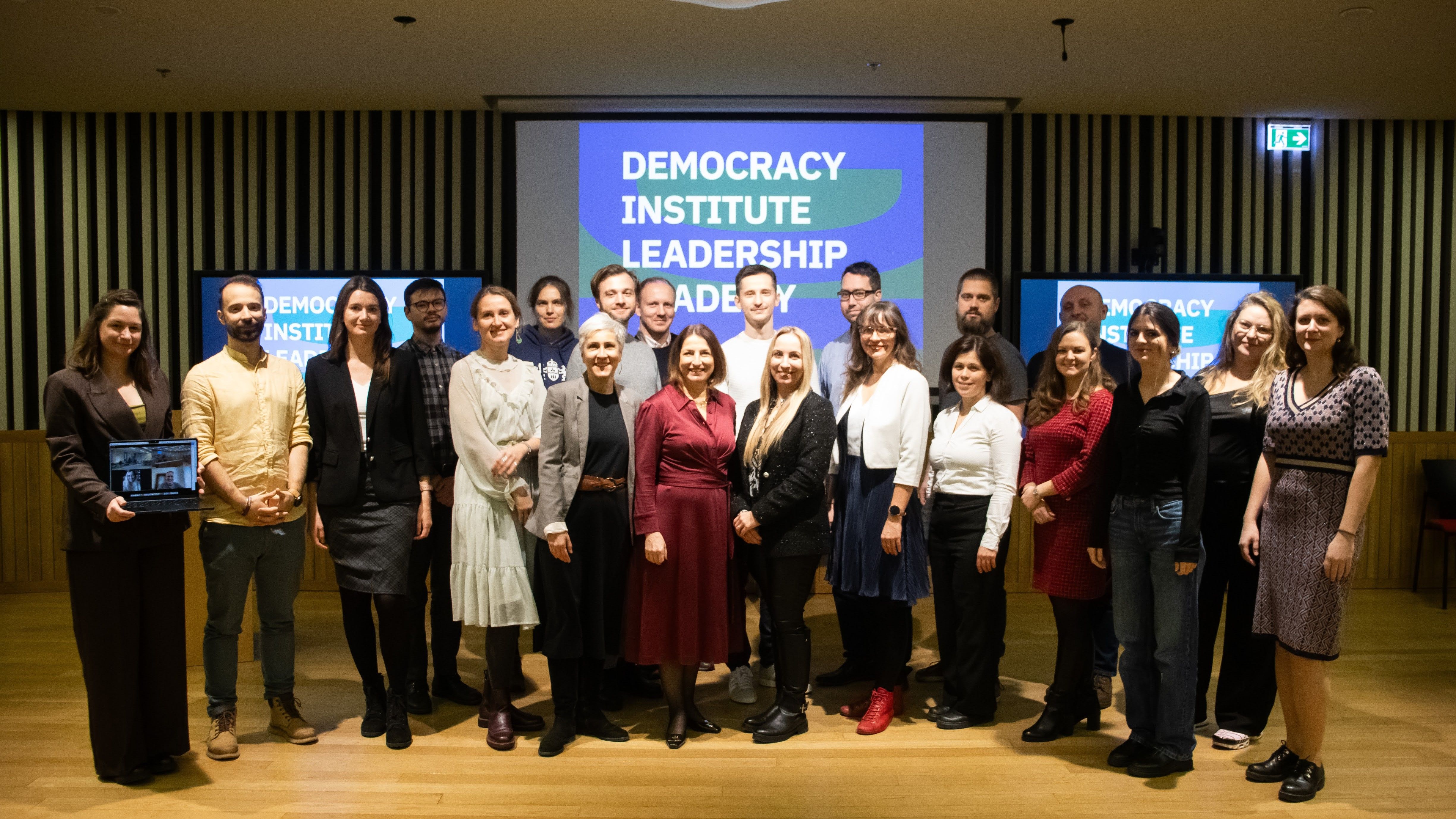
We invite mid-career public leaders, civil society activists, and policy experts from across Central Europe, Southern Europe, and the Western Balkans to join our unique leadership learning journey. Over three months, the program equips fellows with the knowledge, strategic mindset, and practical skills to navigate complex global challenges, understand democratic processes, and operate more effectively in public life. Don't miss this opportunity to strengthen democracy in your community, apply by June 5! Learn more about the program here.
New Project Examines Migration Governance, Integration Pathways and ‘Transconnectivity’ Through Interdisciplinary Social Science Research
CEU is one of the seven universities that partner in the new CIVICA Research Hub: TRANSCONNECT - Rethinking Migration and Integration Governance in Europe. In the DI, the project is led by our Senior Research Fellow Violetta Zentai. The project focuses on how migration and integration are governed at different levels - local, national, and European- and how universities can contribute social science expertise to real-world challenges through universities and civic engagement.
Hungarian Election Brings Record-Breaking Visibility to DI Researchers
The election in Hungary, which brought an end to the 16-year rule of Viktor Orban, attracted intense global attention, with our researchers frequently cited in leading international media. In the days leading up to the vote, Balint Magyar and Balint Madlovics explained the stakes in Foreign Affairs, Zsuzsanna Szelenyi provided an in-depth explanation of the regime in The Economist, she and Andras Bozoki spoke to The Wall Street Journal, while Balint Magyar appeared on CNN on election day. Following the election, Zsuzsanna Szelenyi analyzed the results and their implications on CNN and Channel 4, Zsolt Enyedi on BBC, Balint Magyar on ORF, Eva Bognar and Edit Zgut-Przybylska on TVP World. Furthermore, Peter Kreko was quoted by ABC News and Politico, Zsolt Enyedi by Spanish news agency EFE, Zsuzsanna Szelenyi and Zsolt Enyedi by NPR, Andrea Peto in Nature, while SME interviewed Balint Mikola. Further contributions included op-eds by Laszlo Bruszt for Project Syndicate, Zsuzsanna Szelenyi and Peter Kreko for The Guardian, and Filip Milacic for Der Standard.
Review of Democracy Publishes Series Analyzing the Election in Hungary
Our journal, the Review of Democracy, also published a series of in-depth analytical pieces. Ahead of the election, Balint Mikola assessed its stakes and outlined possible scenarios. Following the vote, Ferenc Laczo reflected on the results, Gabriela Greilinger examined the foreign policy implications, Maria Skora considered what Hungary can learn from Poland, and Zsuzsanna Vegh analyzed the broader lessons for electoral autocracies.
New Book by Edit Zgut-Przybylska
Our Research Affiliate Edit Zgut-Przybylska explores the similarities and differences between the Orban regime and the Kaczynski regime in her new monograph published by Routledge. The book is about the nature of informal governmental power in Hungary and Poland and highlights the key differences and similarities between the two regimes.
RESEARCH
DE- AND RE-DEMOCRATIZATION
Confronting Goliath: Discussion Series on the Hungarian Election
In the run-up to the general election in Hungary, we organized a discussion series titled "Confronting Goliath: Hungarian Autocratic Elections in Comparative Perspective." Coordinated by our Post-doctoral Researcher Balint Mikola, the series aimed to provide theoretical and comparative reflections on the prospects of democratic restoration. In seven regular and two special sessions, it tackled key issues related to the election and a possible regime change, from the media to religion and ideology, how to dismantle an oligarchic economic system, and to the returning to the rule of law.
Policy Papers Based on 2025 Democratic Expeditions Workshop Published
Democratic Expeditions is a joint program of the Friedrich Ebert Stiftung’s Regional Office on Democracy of the Future in Vienna, the CEU Democracy Institute, and the CEU Department of Political Science. The program held a workshop titled “Contesting the Far Right, Safeguarding Democracy: Comparative Insights from Europe and Latin America,” resulting in a series of policy papers. Browse them here.
DEMOCRACY IN HISTORY
Workshop on Reversing Epistemic Racism and Decoloniality during Democratization in Southeast-Central Europe
As part of the preliminary research supported by the DI Seed Fund, Francesco Trupia and Sven Milekic, together with Marta Haiduchok and Tevfik Rada, organized a workshop that brought together both early-career and senior scholars to examine the historical and ideological dimensions of racialization under state socialism from the late 1970s through the 1980s. Learn more here.
Alexandre Lefebvre Gave Talk on the Good Life State
In his seminar, Alexandre Lefebvre explained that his research began from a simple observation: across countries as different as China, India, Russia, Israel, and MAGA America, politics is once again taking up an old question that secular liberal democracies have tried to bracket: what it means to live well, and what kind of person a society should try to form.
ENVIRONMENT AND DEMOCRACY
First Seminar Series of the Observatory for Just Transitions
The Observatory for Just Transitions launched its first dedicated online Seminar Series on "What is a Just Green Transition? Debating the Economic and Democratic Challenges of Greening Capitalism" as a partnership of the DI, CEU's Doctoral School, and the Copenhagen Business School. The hybrid seminar series physically hosted in Copenhagen has attracted over 250 participants from all over the world, confirming the global and interdisciplinary interest for genuine debate on the political economy of decarbonization. The Observatory will build on this success in the upcoming months by proposing new initiatives which will expand global collaboration in research and education around green industrial policies and just transitions.
Launch of Citizen Deliberation Academy Approaching
Preparations are underway for the launch of the beta version of the online platform for the Citizen Deliberation Academy (CDA), which will include two self-directed courses and an information clearinghouse, employing a modular approach to hybrid adult/higher education and outreach. The content is based on the tools and methods identified in the successful Horizon project “REAL DEAL” focused on the rapid developments in innovative forms of deliberative democracy and citizen engagement such as citizen assemblies alone and in combination.
INEQUALITIES
A Pre-Election Look at Disability Rights in Hungary
The public event “What Have Past Governments Done for Us?” in March was one of the first-ever events in Hungary focused on disability, marking a major milestone in the DI’s contributions to informing and engaging people with disabilities in political life. It assessed Hungarian governments' records on disability rights ahead of elections. Learn more here.
Feminist Futures Workshop Highlights Alliance Building and Democratic Resilience Across Europe
Organized by the CCINDLE Project and the DI, the workshop, the first on of a new series, brought together over 130 activists, researchers, politicians, and members of the public from 15 countries to explore how feminists are resisting anti-gender and anti-democratic movements across Europe and beyond.
RULE OF LAW
EU Advocate General Cites Research by Barbara Grabowska-Moroz in Opinion
The paper "The Role of Civil Society in Protecting Judicial Independence in Times of Rule of Law Backsliding in Poland," by Barbara Grabowska-Moroz and Olga Sniadach was cited in the Opinion of an Advocate General of the Court of Justice of the European Union in a high-profile case concerning judicial independence. Learn more here.
New Article in European Law Journal
The EU's supremacy rule of law, which might or might not be an attack on the essential aspects of legality and justice, is in the service of an ever-fading depoliticized democracy of means, Dimitry Kochenov and Jacquelyn Veraldi write in their paper published in the European Law Journal.
PODCASTS
Democracy in Question - Zsolt Enyedi on the Hungarian Election
Host Shalini Randeria speaks with our Senior Research Fellow Zsolt Enyedi about the landmark 2026 Hungarian elections.
Andreas Schedler Discusses the Hungarian Election
Our Acting Academic Director Andreas Schedler shared his assessment of the Hungarian election results on the Vive l’Europe! podcast.
Zsuzsanna Szelenyi in the "Unpacking Europe" Podcast
Zsuzsanna Szelenyi, Program Director of our Leadership Academy, sat down for the Centre for European Reform's Unpacking Europe podcast to take a detailed look at Hungary's landslide election outcome.
Zsolt Enyedi in The Conversation Weekly Podcast
Zsolt Enyedi was the guest of The Conversation Weekly podcast series, to discuss how Peter Magyar became the leader who defeated Viktor Orban.
European Security at a Turning Point: Munich Insights for Ukraine, EU and Transatlantic Relations
In the first episode of our new podcast series “EU Integration Dialogues: Ukraine Edition,” produced by the ADVANCE-EUiUA and the ENTENTE projects, hosts Inna Melnykovska and Marta Beska discuss the key outcomes of the Munich Security Conference with Erik Jones and Veronica Anghel.
Built Under Fire, Hitting Bureaucratic Walls: Ukrainian Defense Tech and the Strategic Autonomy Test of EU Enlargement
The second episode of the series features Mattia Nelles and Ihor Masiakin and discusses the development and integration of Ukraine’s defense tech sector.
REVIEW OF DEMOCRACY
The Review of Democracy (RevDem) is our online journal to discuss, analyze, reflect on, and develop possible solutions to the challenges to democracy across the globe today. Check its most important publications from recent weeks:
Why Would Elected Leaders Hollow Out Their States?
In this episode of the podcast series produced in collaboration with the Journal of Democracy, Andrés Mejía Acosta and Javier Pérez Sandoval discuss how, why, and when elected leaders seek to undermine the state.
Democracy on a Tightrope: Politics, Bureaucracy, and the Risks of Imbalance
Gabriela Lotta explores the risks that emerge when the relationship between politics and bureaucracy breaks down: the rise of technocratic governance and the “fetishization of meritocracy, and the erosion of bureaucratic institutions by political leaders.
Ultimate Failure Via Major Accomplishments
Julian E. Zelizer – editor of the new volume The Presidency of Joseph R. Biden. A First Historical Assessment – discusses with Ferenc Laczo the key accomplishments of Joe Biden’s presidency as well as the sources of his ultimate failure to fulfil his promise.
Talking Democracy While Tearing It: Authoritarian Conservatism in New Order Indonesia
Indonesian conservative thinkers claimed to save their country from populist socialism of Sukarno and the Left. They dreamed of a democratic polity free from “extremism” and underdevelopment. Instead, what they built was an authoritarian, corporatist, and developmentalist regime. Iqra Anugrah (re)examines their ideological justification for it.
Anticipating Autocracies: A History of Contemporary China
Minxin Pei challenges the enduring assumption that economic development naturally leads to democracy.
Kast’s “Emergency Government”: Early Signals of Democratic Narrowing from Within
Democratic erosion does not always arrive through rupture. In Chile, early decisions by Jose Antonio Kast’s government suggest a subtler process: the gradual narrowing of democracy from within, Lisa Zanotti argues.
Costa Rica’s “Third Republic” and Refoundational Authoritarianism
Costa Rica’s “Third Republic” is not just a political slogan but a narrative that turns accountability into obstruction and reframes democratic oversight as a relic of a failed past, Jesus Guzman-Castillo writes.
How Helpful Are AI Tools for Autocrats?
L. Jason Anastasopoulos and Jie (Jason) Lian discuss the new challenges and opportunities for repression that AI poses.